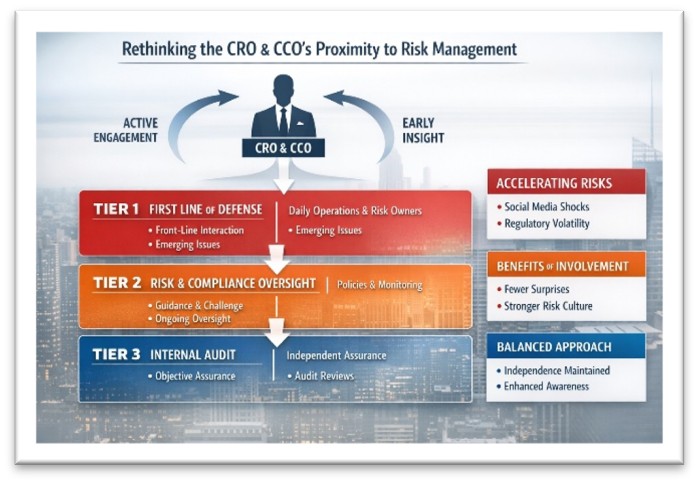
I guess what I’m asking is should we be rethinking the CRO and CCO’s Proximity to the Front Line.
The traditional “three lines of defense” model has long provided a clear and logical framework for risk management and compliance. Tier 1 owns and manages risk, Tier 2 oversees and challenges, and Tier 3 independently assures. The structure is elegant, defensible, and regulator-friendly.
But in today’s environment—defined by geopolitical shocks, social media amplification, rapid regulatory change, and economic volatility—the question is no longer whether the model is sound. It’s whether how we operate within it remains fit for purpose.
At the heart of this discussion is a question I would ask felloe CROs and CCOs: How close should I be to the first line of defense?
Proximity to Tier 1: Independence vs. Insight
Conventional wisdom says that Tier 2 must maintain distance from Tier 1 to preserve independence. That principle still holds. However, distance should not mean detachment.
Risk and compliance failures rarely stem from a lack of policies. They arise from misunderstandings, operational pressures, cultural blind spots, or weak escalation. These are best identified not through dashboards alone, but through regular, informed engagement with the front line.
A CRO or CCO who understands how risks are actually being taken, managed, and rationalized day-to-day is better positioned to challenge effectively. Proximity enables context. Context improves judgment. And judgment is ultimately what regulators expect from senior control functions.
The key distinction is this: advising, observing, and challenging is not the same as owning or executing. Independence is preserved through clarity of accountability, not physical or intellectual distance.
What About Tier 2 and Audit?
If Tier 2 is too far from Tier 1, it risks becoming reactive—discovering issues only once they’ve crystallized. But if Tier 2 becomes too operational, it risks role confusion and diminished credibility.
The same tension exists with audit. Audit’s independence is sacrosanct, yet its effectiveness improves when it understands the real risk landscape rather than a theoretical one.
Strong CROs and CCOs act as connective tissue—ensuring insights from Tier 1 inform Tier 2 oversight and audit planning, without compromising the independence of either.
Does This Pull You Away from Your Core Duties?
Yes, increased engagement with the front line can feel like a distraction from core CCO or CRO responsibilities—regulatory interpretation, policy governance, board reporting, and supervisory interaction.
But there are tangible benefits:
- Earlier identification of emerging risks
- Fewer surprises escalated late
- Stronger risk culture and credibility
- More meaningful challenge, not just checklist oversight
In practice, time spent closer to the front line often reduces downstream remediation, regulatory friction, and reputational risk—arguably the most time-consuming outcomes of all.
The Pace of Change Demands a Different Model
The velocity of modern risk has fundamentally changed escalation dynamics. Issues can become public before they become internal. Social media can transform minor operational errors into brand-threatening events within hours. Political or regulatory shifts can invalidate existing controls overnight.
In this environment, waiting for risks to “filter up” through supervisory layers may no longer be sufficient.
This raises a critical question: should C-suite executives—particularly CROs and CCOs—be more actively engaged earlier in the risk and compliance lifecycle?
Increasingly, the answer is yes.
Is the Traditional Escalation Model Outdated?
I would say that the model itself is not outdated—but relying on it passively might be.
Escalation should still occur through defined channels, but senior leaders should not depend solely on formal reporting cycles to surface material risks. Active engagement, informal check-ins, and direct visibility into emerging issues provide a necessary complement to traditional governance structures. In effect, walk the office floor and have those informal watercooler talks.
This does not mean bypassing management layers. It means enhancing situational awareness.
A More Active C-Suite Role—Without Blurring the Lines
The future likely belongs to CROs and CCOs who are:
- Visible, but not operational
- Engaged, but not directive
- Informed early, but disciplined in escalation
Being closer earlier does not undermine the three lines of defense—it strengthens them.
In a world where risks emerge faster, louder, and with greater consequence, the real risk may not be being “too close” to the front line—but being too far away, for too long.