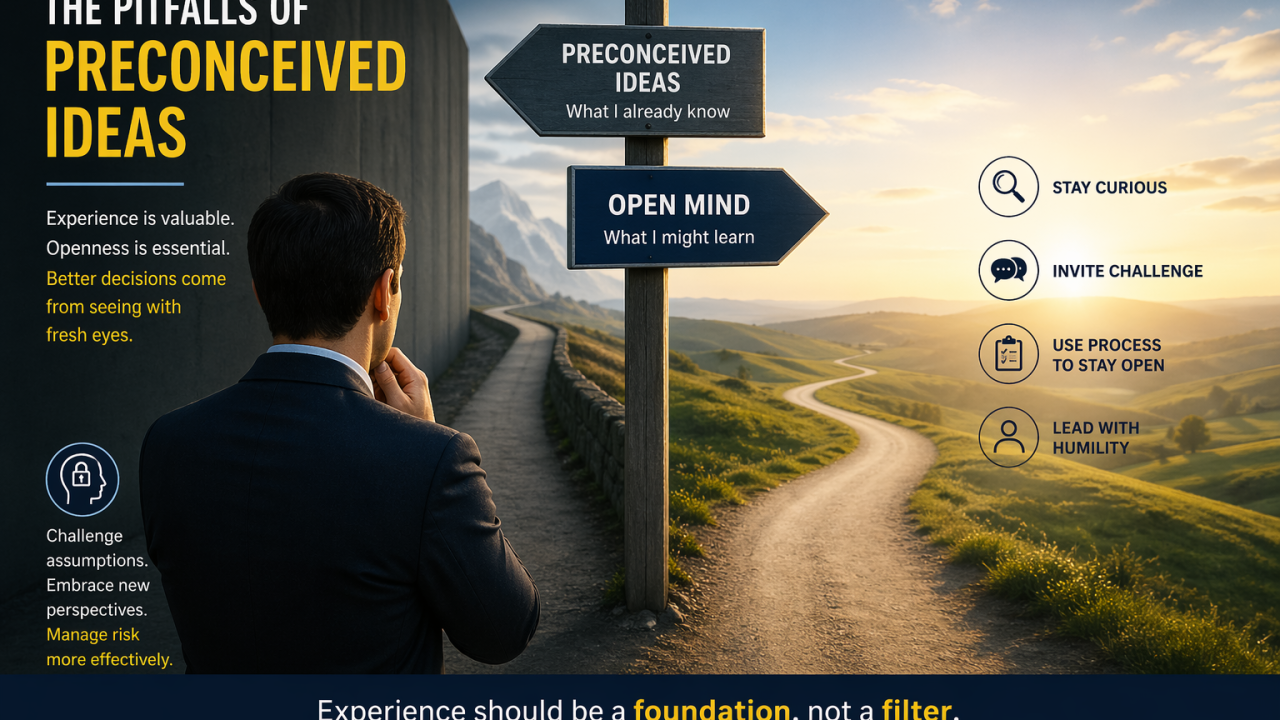
A recent conversation reminded me of something uncomfortable—but important. Experience, which we often wear as a badge of credibility and honour, can quietly become a barrier to new thinking. Which got me thinking.
In risk management, experience is invaluable. It sharpens judgment, builds pattern recognition, and helps us anticipate issues before they materialize. But it also comes with a hidden cost: the tendency to rely on preconceived ideas. When we’ve “seen it before,” we may stop truly seeing what’s in front of us. Do we really see the forest and not the trees?
That’s the pitfall.
Preconceived notions are efficient. They help us move quickly. But they can also lead us to filter out new information that doesn’t fit our existing mental models. In a field like risk management—where emerging risks rarely look exactly like past ones—that can be a significant vulnerability.
So the question becomes: how do we demonstrate, both to ourselves and to others, that we are open to new ideas?
First, it starts with awareness. Recognizing that experience can create blind spots is not a weakness; it’s a strength. The most effective risk managers are not those who assume they know, but those who continuously test what they think they know.
Second, it requires intentional curiosity. That means asking more questions than making statements. Instead of framing a situation through the lens of “this looks like X,” we can shift to “what might I be missing here?” or “how is this different from what I’ve seen before?” These small changes in approach create space for new insights.
Third, we need to actively invite challenge. In many organizations, especially those with strong hierarchies or experienced leadership, dissenting views can be unintentionally discouraged. As risk professionals, we should do the opposite—encourage alternative perspectives and reward thoughtful pushback. It’s often in those moments of constructive tension that the most valuable insights emerge.
Fourth, we can demonstrate openness through process. This might include structured decision-making frameworks that require consideration of multiple scenarios, or post-mortem reviews that explicitly examine where assumptions may have influenced outcomes. When openness is built into the process, it becomes less dependent on individual mindset.
Finally, humility plays a critical role. Experience should give us confidence, but not certainty. The risks that matter most are often the ones that don’t fit neatly into our past experiences. Being willing to say “I don’t know” or “this may be different” signals both credibility and adaptability.
For those of us in risk management, this is more than a personal development exercise—it’s a professional obligation. Markets evolve. Regulations change. Organizational dynamics shift. If we approach these changes with rigid expectations, we risk becoming part of the problem rather than part of the solution.
The irony is that true expertise is not about having all the answers. It’s about knowing how to question your own answers. Experience should be a foundation, not a filter. The challenge—and the opportunity—is to use what we know without being limited by it.
Why Post
The idea behind postings on this platform is to ask questions. Also, hopefully provide ideas, concepts or thoughts that highlight the challenges facing risk and compliance managers in the corporate governance structure. These postings are based on my personal experience, the experiences of others, and developing my understanding of the many leadership challenges, through publications and literature.
It’s my desire to help close the perceived negative gaps between corporate governance and risk/compliance management. There are ways and means to enhance the relationship, which I’ve focused on for several years. Direct message me for additional information on how to create a collaborative governance environment